
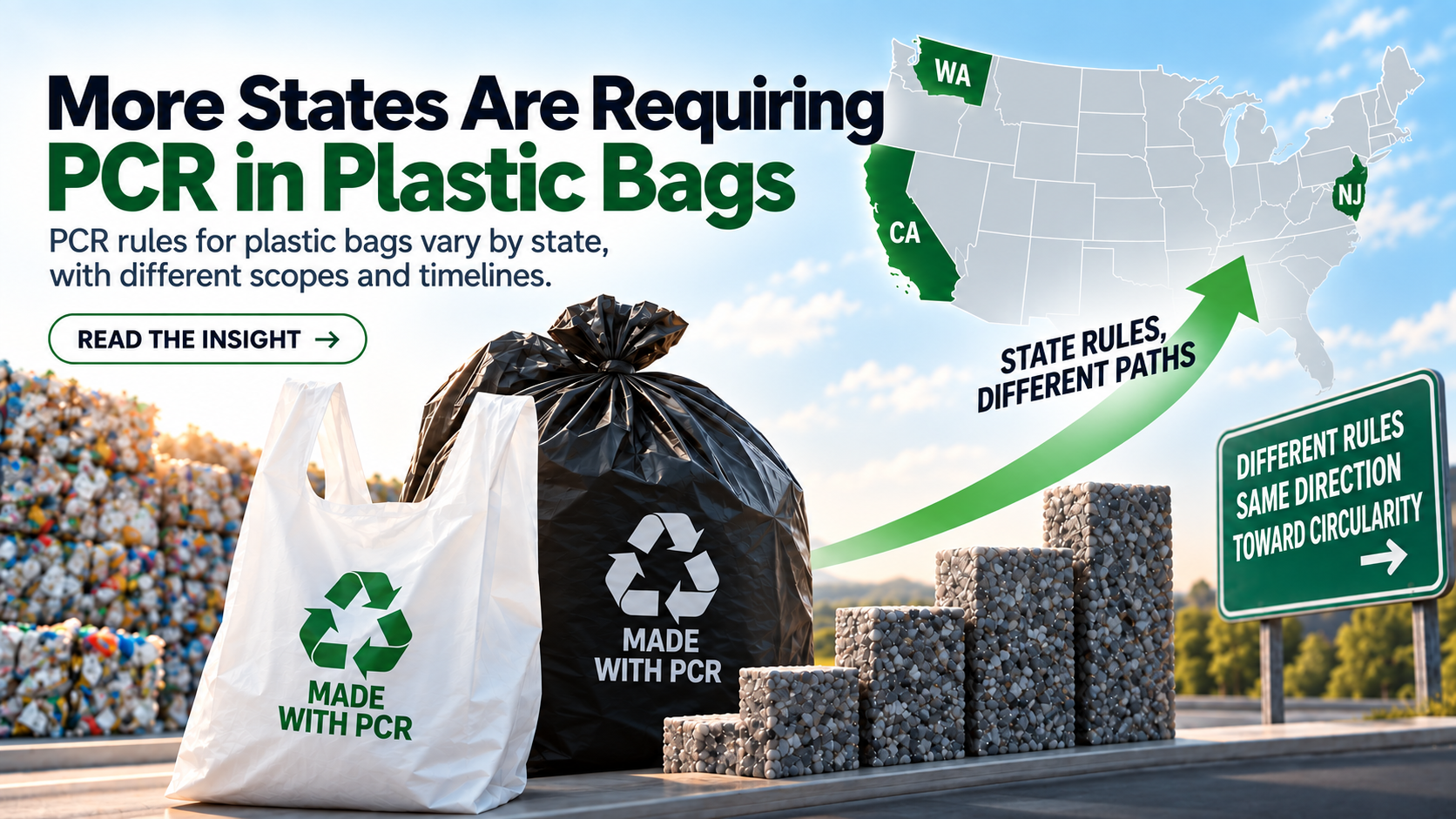
- New Jersey's carryout bag and trash bag PCR requirements — covered in our September 22 Insight — aren't an isolated case. California, Washington, Maine, and Connecticut have each enacted their own postconsumer recycled (PCR) content laws, and for most covered categories, they follow the same structure: a minimum percentage that starts low and rises on a fixed schedule.
- Washington requires 10% PCR in trash bags starting 2023, rising to 15% in 2025 and 20% in 2027 — closely mirroring New Jersey's tiered approach. California has required 10% PCR in trash bags since 1998, one of the earliest rules of this kind in the country.
- The requirements are rising faster than PCR resin supply in some cases. Industry reporting has pointed to persistent bottlenecks — high-quality PCR meeting only a small share of global plastics demand, with food-grade material especially constrained and, depending on polymer type, geography, and market conditions, sometimes priced above virgin resin.
- As PCR demand keeps rising across these states, supply may not always keep pace — which makes identifying a stable, certified supply source in advance, rather than reacting once a new requirement takes effect, an increasingly important part of sourcing strategy.
- REGENPLAST's GRS-certified PCR carryout bags and trash bags/can liners are well positioned to help meet this kind of multistate requirement — buyers already sourcing against New Jersey's and Washington's current thresholds may be able to carry the same certified PCR supply into other states as their requirements phase in, rather than starting sourcing over in each one, though the extent of that overlap depends on each state's specific product scope and percentage requirements. (GRS certification confirms the recycled content in the material itself; it isn't a substitute for a state's own product scope, registration, reporting, or PCR-calculation rules, which buyers should confirm separately for each state.)
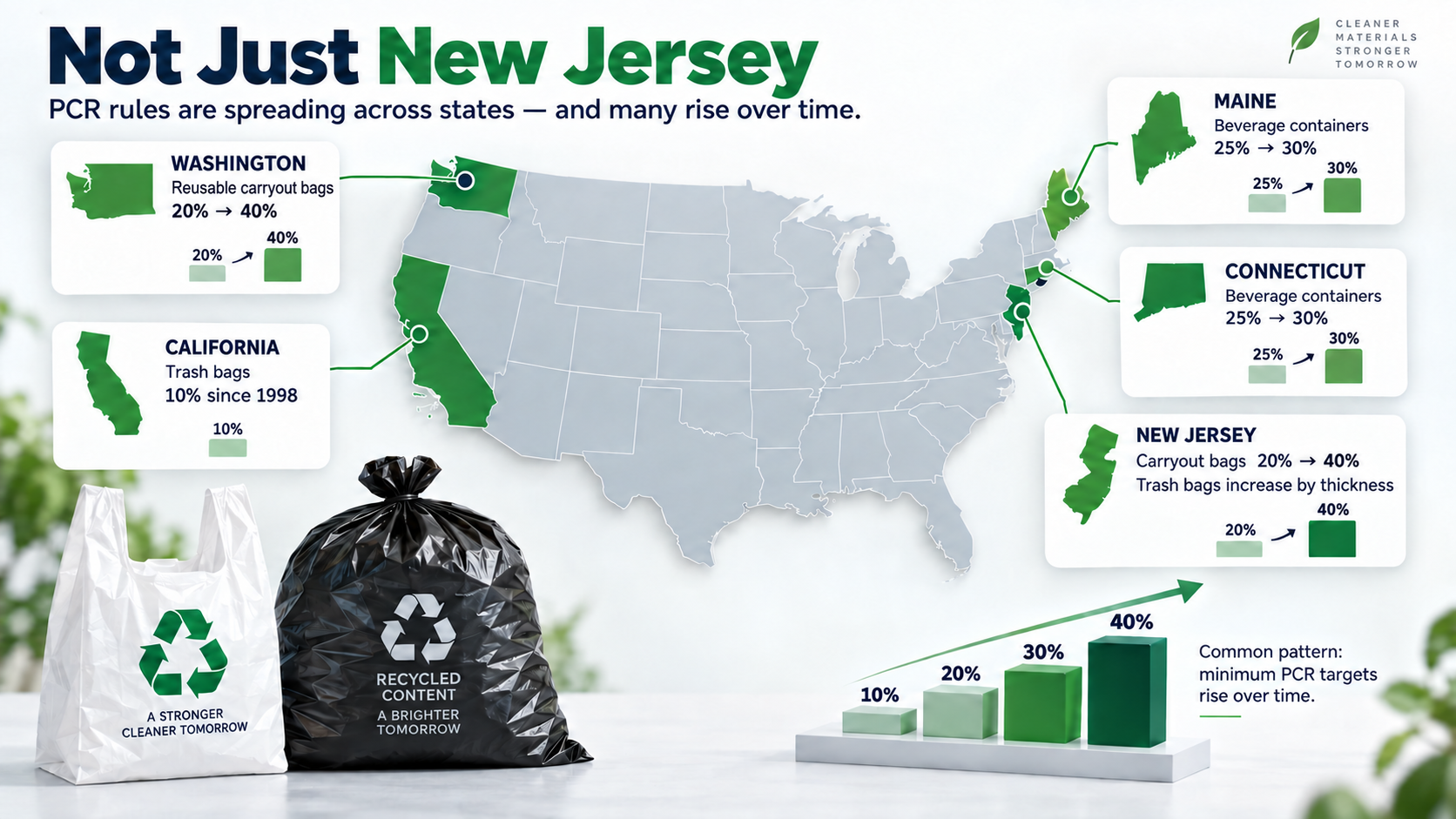
No. New Jersey requires PCR content in both plastic carryout bags and trash bags. Plastic carryout bags must contain 20% PCR since 2024, rising to 40% in 2027, with no capacity limit. (New Jersey separately sets a static threshold for paper carryout bags only — 20% for bags holding 8 pounds or less, 40% for bags holding more than 8 pounds — which does not apply to plastic carryout bags.) Trash bags follow a schedule tiered by film thickness: 5% rising to 10% for bags thicker than 0.70 mils but less than 0.80 mils, 10% rising to 20% for bags thicker than 0.80 mils but less than 1.00 mils, and 20% rising to 40% for bags 1.00 mils thick or more. These New Jersey requirements sit inside a broader pattern. California, Washington, Maine, and Connecticut have each passed their own postconsumer recycled content laws over the past several years, and most share the same underlying structure: lawmakers set a minimum PCR percentage, then schedule it to increase in fixed steps over time, rather than mandating a single fixed target. (California's longstanding trash-bag rule, discussed below, is a notable static example: it provides two fixed compliance pathways rather than a scheduled increase.)
That escalating structure shows up across very different packaging categories. Washington phases beverage bottles from 15% (2023) to 25% (2026) to 50% (2031). California takes plastic beverage bottles from 15% (2022) to 25% (2025) to 50% (2030). Maine's newest law brings beverage containers to 25% starting January 2026, stepping up to 30% in 2031. Connecticut's law follows the same shape, requiring 25% by January 2027 and 30% by January 2032. The percentages and the packaging types differ state to state, but starting low and escalating on a published timeline is now a common template for newer laws. California's original 1998 trash-bag rule, by contrast, established two static compliance pathways: at least 10% recycled plastic postconsumer material in regulated bags, or at least 30 percent of the weight of the material used in all of a manufacturer's plastic products intended for sale in California being recycled plastic postconsumer material. Neither pathway has a scheduled future increase.
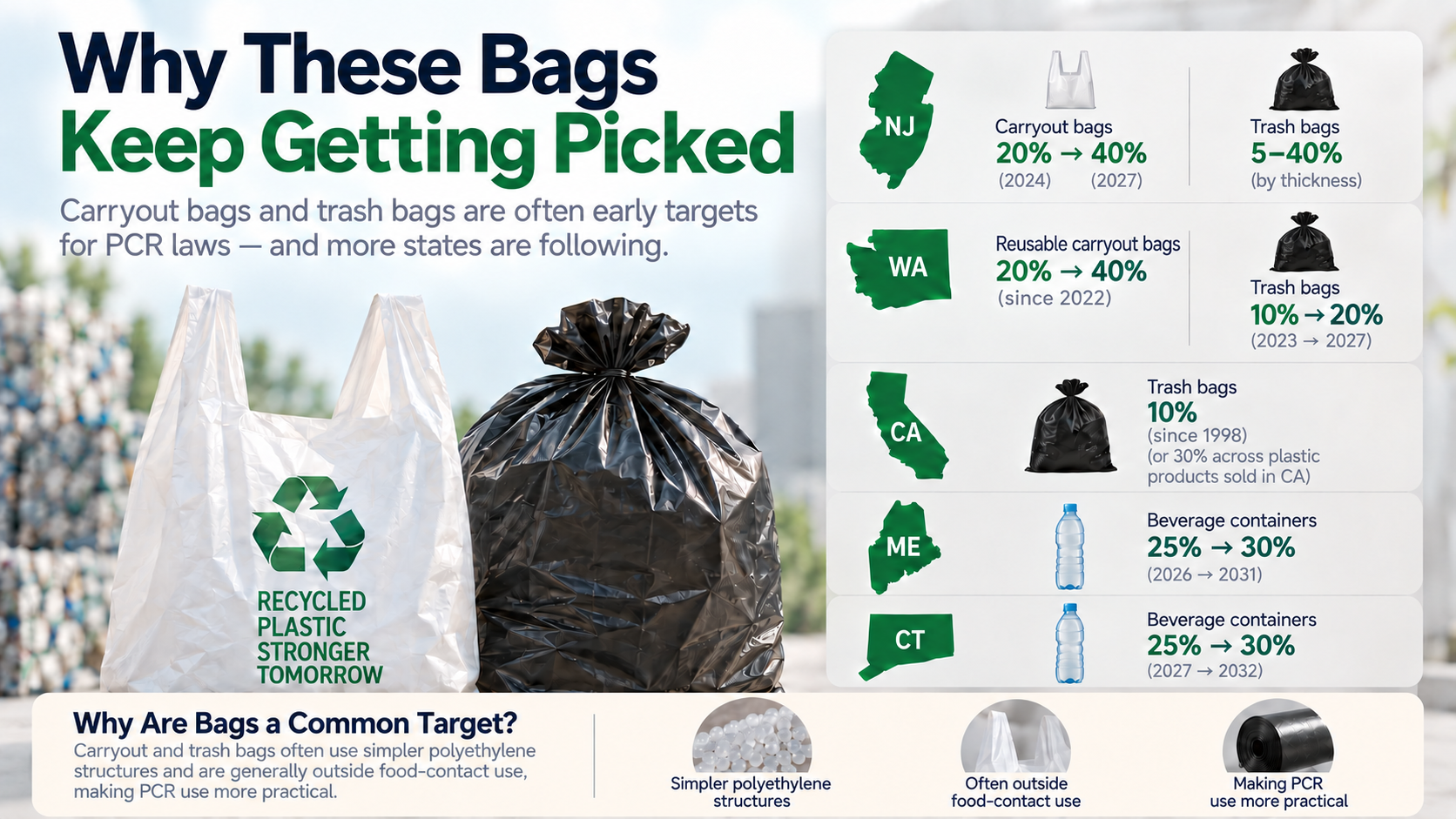
Not every state applies this structure to bags specifically. Maine's and Connecticut's laws, for instance, currently target beverage containers only. But where lawmakers have chosen to regulate bags, the pattern is consistent: New Jersey covers both carryout bags and trash bags, and Washington does the same — requiring 10% PCR in trash bags starting in 2023, rising to 15% in 2025 and 20% in 2027, alongside a requirement that reusable, film-plastic carryout bags contain 20% PCR content, rising to 40% since July 2022. This operates alongside Washington's separate restrictions on single-use plastic carryout bags; the PCR requirement applies to reusable film-plastic carryout bags that retailers may provide. California's trash bag rule has been in place since 1998 — one of the earliest PCR mandates of any kind in the country, well before the current wave of state packaging laws. It gives manufacturers a choice: 10% PCR content in each individual trash bag, or, alternatively, ensuring that at least 30 percent of the weight of the material used in all of the plastic products they intend for sale in California is recycled plastic postconsumer material; either path satisfies the law, and neither has a scheduled future increase.
Carryout bags and trash bags are often comparatively suitable applications for PCR because they commonly use simpler polyethylene constructions and are generally outside food-contact use. That relative technical fit may help explain why bag-specific PCR requirements have been feasible in some states, while certain food-contact applications have faced more substantial technology, quality, and supply constraints.
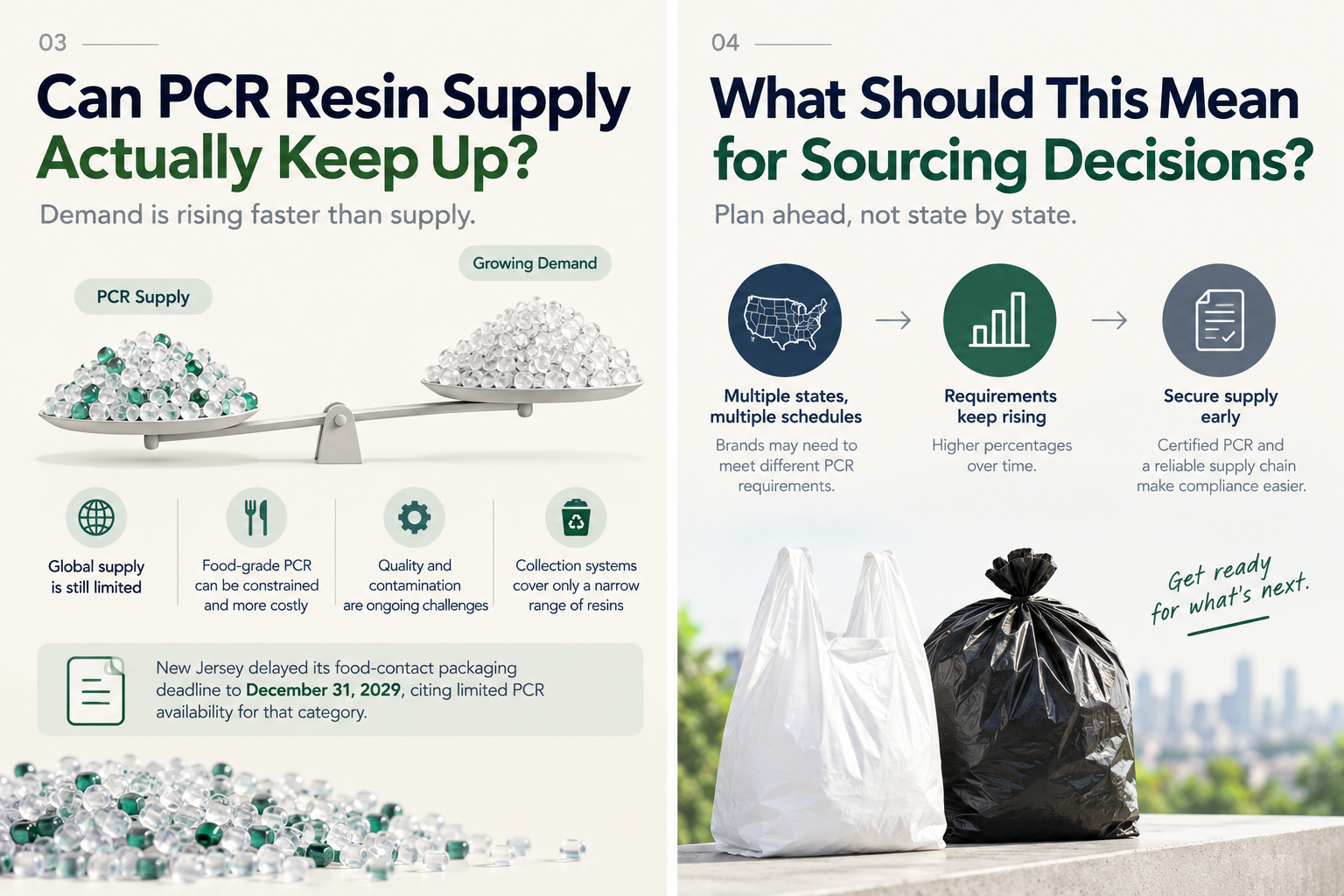
This is the tension underneath all of these laws: the required percentages are rising on a fixed calendar, but PCR resin supply doesn't scale on the same schedule. Industry reporting has repeatedly flagged this gap. Recycled plastics currently meet only a small fraction of global plastics demand, and food-grade PCR in particular can be especially constrained and may command a premium over virgin resin, depending on polymer type, quality specification, geography, and market conditions — a constraint large consumer brands have also acknowledged publicly while working toward their own recycled-content commitments. Contamination and inconsistent feedstock quality further limit which applications PCR can reliably serve, and most curbside collection systems are still built around a narrow set of resin types.
New Jersey's own recent decision to push back its food-contact packaging deadline to December 31, 2029 — covered in our September 22 Insight — was justified by regulators on exactly this basis: PCR technology for that category isn't yet available at commercial scale. Bag requirements, by contrast, have generally continued moving forward on their original schedules — which may reflect how much more readily these supply pressures have been absorbed for bag categories compared with food-contact packaging.
For buyers of carryout bags and trash bags and can liners, the practical takeaway is that this isn't a single-state compliance problem to solve once. A brand selling into New Jersey and Washington today is already managing two overlapping but distinct PCR schedules. As more states adopt similar structures — and as existing ones step up their percentages on schedule — sourcing decisions increasingly need to satisfy whichever state's requirement is strictest at a given time, not just the market a shipment is headed to first.
That argues for locking in certified PCR supply ahead of the next scheduled increase, rather than sourcing reactively state by state as each deadline approaches. Given the supply constraints described above, buyers who have already secured certified PCR material and a documented supply chain are likely to have an easier time adapting as more states adopt this same escalating structure — though the specific requirements they'll need to meet will still depend on each new law's own category, percentage, and reporting rules.
[References]
- Association of Plastic Recyclers (APR), "Recycled Plastic Content Requirements" (state policy tracker) → Read the Source
- Washington State Department of Ecology, "Recycled content minimums" → Read the Source
- Maine Department of Environmental Protection, "Post Consumer Recycled Plastic Content in Plastic Beverage Containers" → Read the Source
- New Jersey Revised Statutes, N.J.S.A. 13:1E-99.142, "Plastic trash bags, percentage of postconsumer recycled content increase" → Read the Source
- Plastics Engineering, "Why 2025 Post-Consumer Recycled (PCR) Targets Are Slipping" → Read the Source