
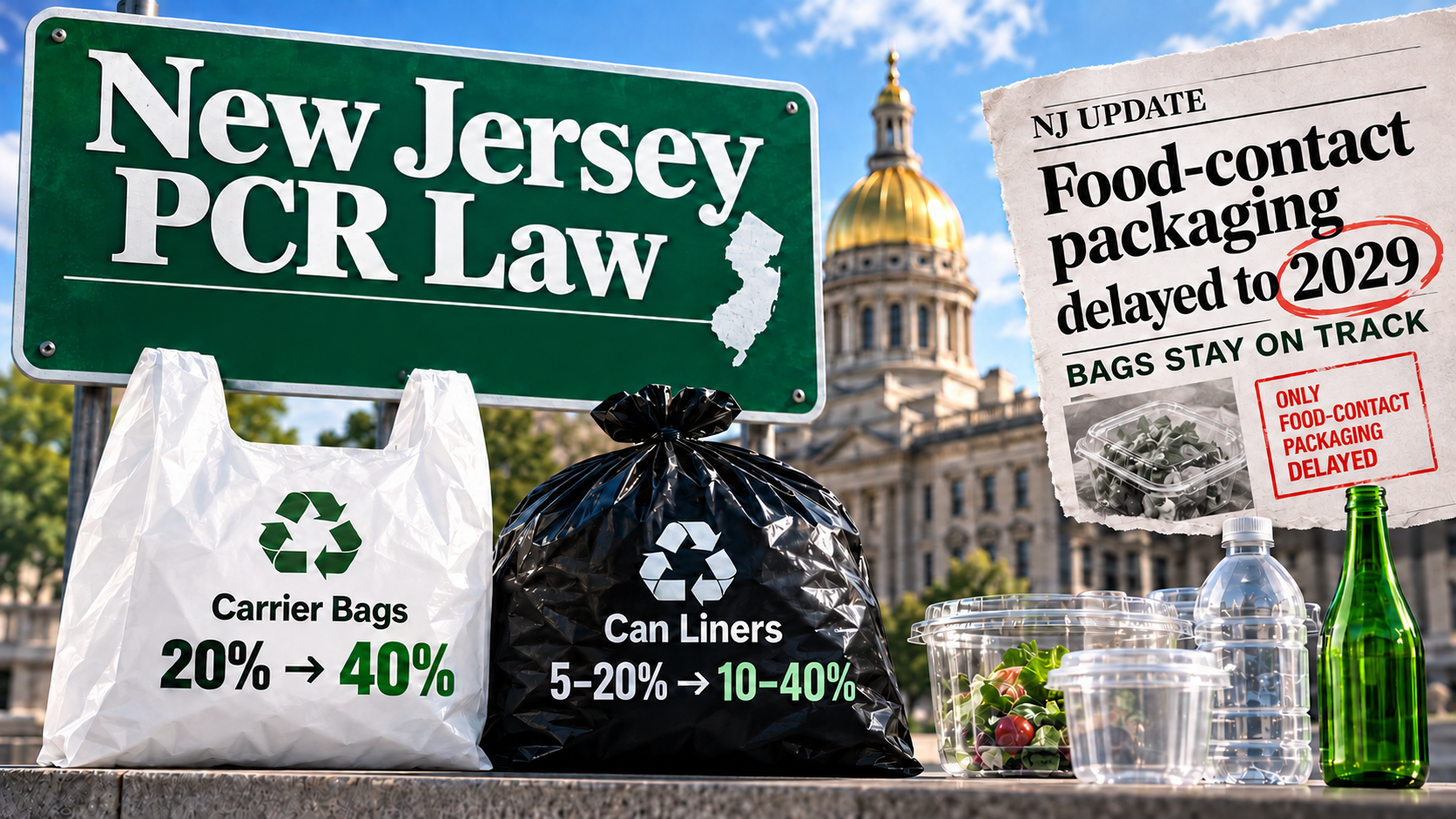
- New Jersey's Recycled Content Law (P.L.2021, c.391 / S2515, signed January 2022) is the most comprehensive state PCR mandate in the U.S. California's SB 54 centers on source reduction and recyclability; this law instead sets a minimum PCR percentage that must be in the product itself.
- Plastic carryout bags require a minimum of 20% PCR as of January 18, 2024, rising to 40% in January 2027. Plastic trash bags follow a tiered schedule by film thickness, from 5–20% in 2024 to 10–40% in 2027 — these are exactly the categories REGENPLAST's T-shirt bags and garbage bags/can liners fall under.
- On September 2, 2026, NJDEP announced a delay that applies only to food-contact packaging, pushing that category's deadline from January 18, 2027 to December 31, 2029.
- Every other category — plastic and paper carryout bags, plastic trash bags, rigid plastic containers, glass containers, and plastic beverage bottles — is unaffected and stays on its original phase-in schedule.
- APR publicly criticized the delay on September 10, 2026, for being made without a formal public comment period.
- REGENPLAST's GRS-certified PCR carryout bags and trash bags/can liners already meet New Jersey's current thresholds, supported by manufacturer test reports that buyers can use as part of their own compliance documentation. For the 2027 step-up to 40% and 10–40%, REGENPLAST can help buyers lock in certified PCR sourcing now, well ahead of the deadline.
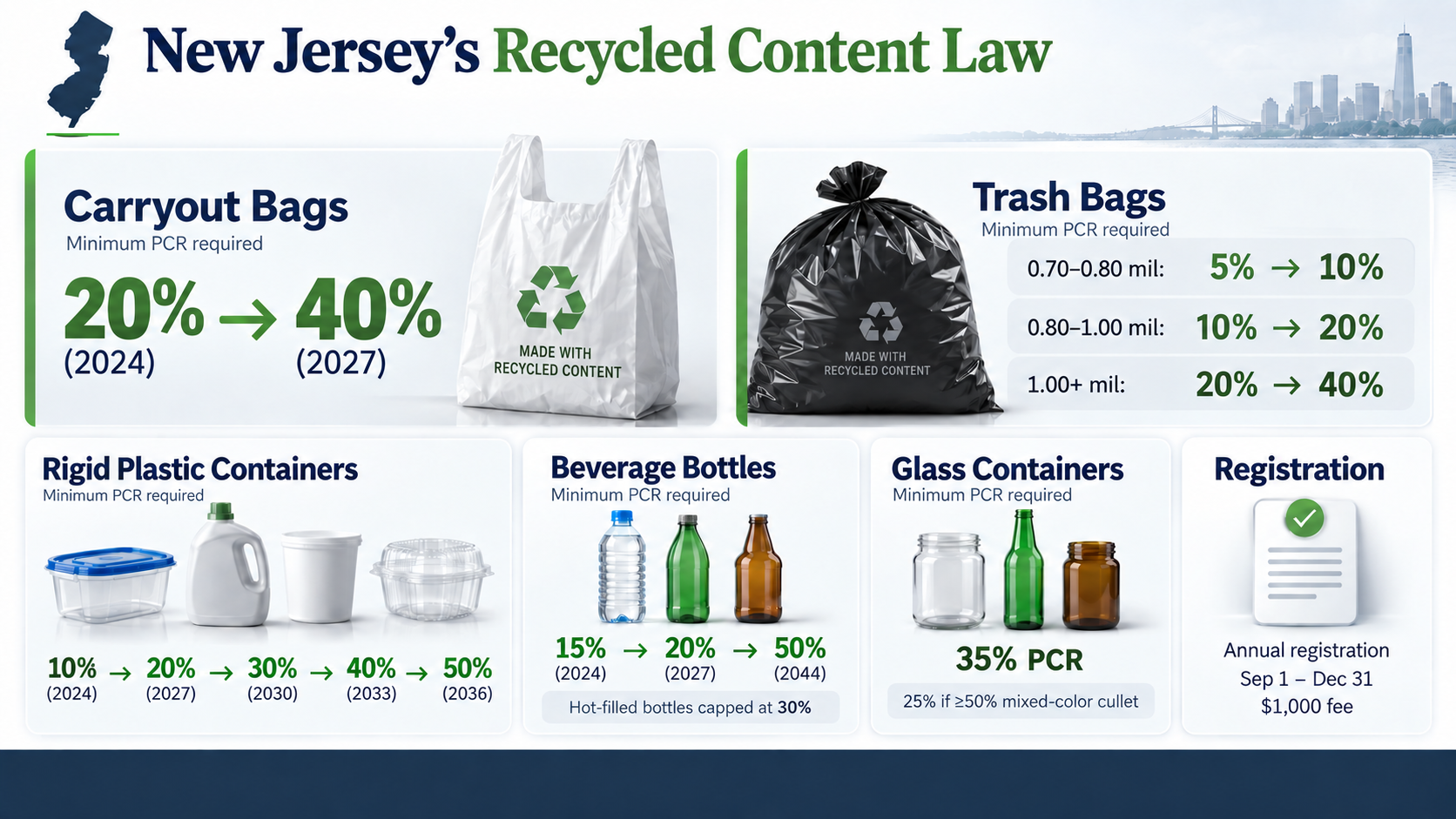
New Jersey's Recycled Content Law, enacted in January 2022, took a different approach from most state packaging rules. California's SB 54 sets recyclability and source-reduction targets. New Jersey's law does something different: it requires manufacturers to put a specific minimum percentage of postconsumer recycled material directly into six packaging categories. That percentage then keeps rising on a fixed schedule.
Two of those categories map directly onto REGENPLAST's core product lines. Plastic carryout bags needed at least 20% PCR starting January 18, 2024. That minimum steps up to 40% in January 2027. Plastic trash bags follow a tiered schedule based on film thickness. Bags 0.70–0.80 mils thick needed 5% PCR in 2024, rising to 10% in 2027. Bags 0.80–1.00 mils needed 10%, rising to 20%. Bags 1.00 mils or thicker needed 20%, rising to 40%.
The other four categories follow their own timelines. Rigid plastic containers climb from 10% in 2024 to 20% in 2027, then 30% in 2030, 40% in 2033, and 50% by 2036. Plastic beverage bottles start at 15% in 2024 and rise to 20% in 2027. After that, the minimum adds 5 percentage points every three years until it reaches 50% in 2044. Hot-filled bottles are capped at 30%, regardless of the year. Glass containers need 35% PCR — or 25%, if the recycled content is at least half mixed-color cullet. Under current rules, manufacturers selling covered products in New Jersey must also register annually, typically between September 1 and December 31, and pay a $1,000 annual fee.
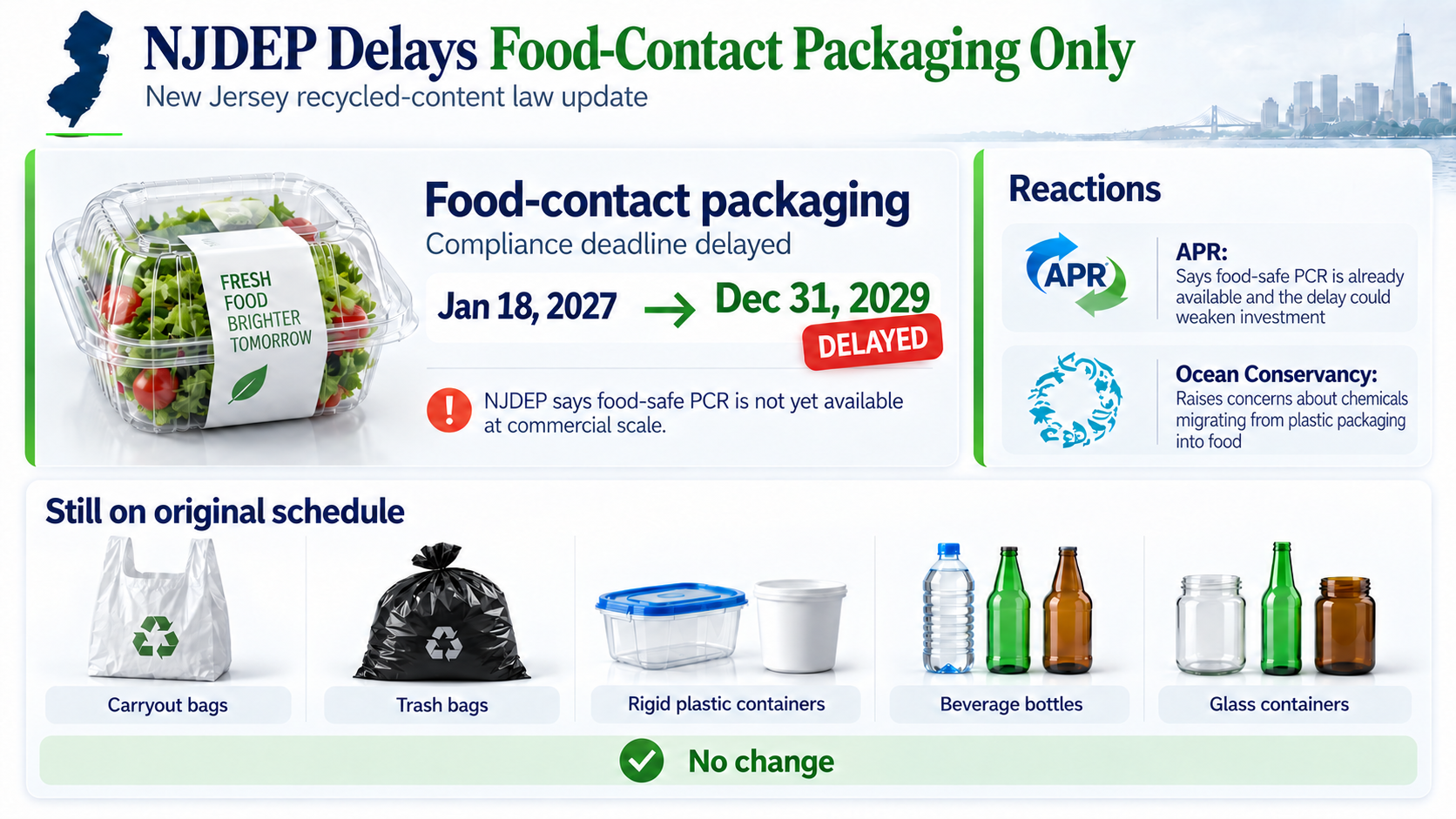
On September 2, 2026, NJDEP announced it would extend the compliance deadline for one category: food-contact packaging. That deadline moves from January 18, 2027 to December 31, 2029. NJDEP's stated reason: food-safe PCR technology isn't yet available at commercial scale. Forcing the issue now, the agency said, could risk food-quality problems.
The reaction split along familiar lines. The Association of Plastic Recyclers said it was "deeply disappointed" by the decision. It argued the delay discounted the proven availability of recycled content. It also said the delay undercut a market signal that had already pushed some manufacturers to invest in food-safe PCR lines. APR raised a separate process concern too: the change came, in its words, "without an opportunity for public comment or meaningful stakeholder engagement." Ocean Conservancy questioned a different premise entirely — whether single-use plastic belongs in food packaging at all, given ongoing concerns about chemicals migrating into food.
What matters for sourcing decisions is how narrow this delay actually is. It applies to food-contact packaging only. It does not touch plastic or paper carryout bags, plastic trash bags, rigid plastic containers, glass containers, or plastic beverage bottles. Every one of those categories stays on its original 2024/2027 schedule.
The September 2, 2026 extension is scoped to food-contact packaging. So the requirements that actually apply to REGENPLAST's core categories haven't moved. The 20% PCR minimum for plastic carryout bags has been in force since January 18, 2024. So has the tiered 5–20% minimum for plastic trash bags, by thickness. The next step is still scheduled for January 2027: 40% for carryout bags, and 10–40% for trash bags.
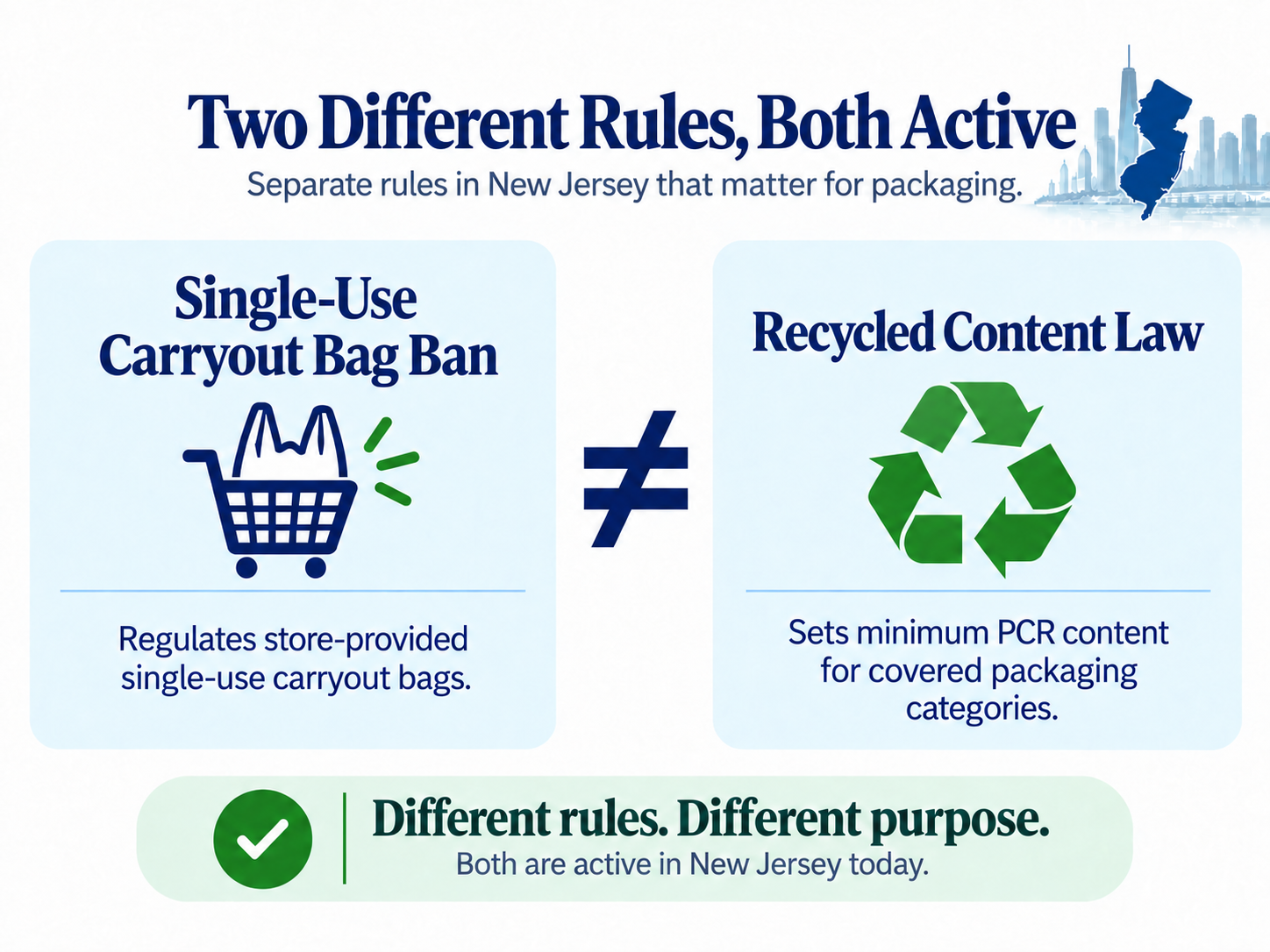
It's worth separating this law from New Jersey's other plastic bag policy. New Jersey's single-use plastic bag ban has been in effect since May 2022. It restricts certain thin, single-use bags from being handed out at checkout in grocery and retail stores. The Recycled Content Law's plastic carryout bag category is a different, separate requirement. It sets a minimum PCR content for carryout bags sold into New Jersey commerce — on top of the ban, not instead of it. Buyers sourcing carryout or trash bags for the New Jersey market should treat both rules as active today, not as something still being finalized.
One open question is what this extension signals. Is it a one-off exception for food-contact packaging? Or an early sign of how New Jersey will handle the January 2027 step-ups in other categories, as that date gets closer? APR's criticism of the process matters here too. There was no public comment period before the change, and that could push future adjustments toward a more formal rulemaking process.
The bigger pattern to track is how many states are now doing this in parallel. New Jersey, Washington, Maine, and Connecticut have each moved toward their own PCR mandates. Each has its own timeline and its own thresholds, alongside California's separate SB 54 framework. For any brand selling into multiple states, sourcing decisions increasingly need to satisfy the strictest requirement in play, not the most lenient one. REGENPLAST will keep tracking New Jersey's law alongside SB 54 as both move toward their 2027 milestones.
[References]
- NJDEP, Division of Sustainable Waste Management, "Recycled Content" (official program page) → Read the Source
- New Jersey Revised Statutes, N.J.S.A. 13:1E-99.142, "Plastic trash bags, percentage of postconsumer recycled content increase" (official statute text) → Read the Source
- Packaging Dive, "New Jersey delays PCR requirements for food-contact packaging to 2030" → Read the Source
- Waste Dive, "New Jersey delays PCR requirements for food-contact packaging" → Read the Source
- PlasticsToday, "New Jersey Postpones Recycled Content Rules Until 2030" → Read the Source
- Berlin Packaging, "New Jersey Recycled Content Packaging" (compliance schedule overview) → Read the Source