
- Permanent regulations approved and in effect: May 1, 2026
- Real enforcement trigger — non-participation starts blocking California sales: January 1, 2027 (about three and a half months out)
- Baseline supply and source-reduction reports: due May 31, 2026; required CalRecycle registration or compliance-pathway selection: due June 1, 2026 (both already passed)
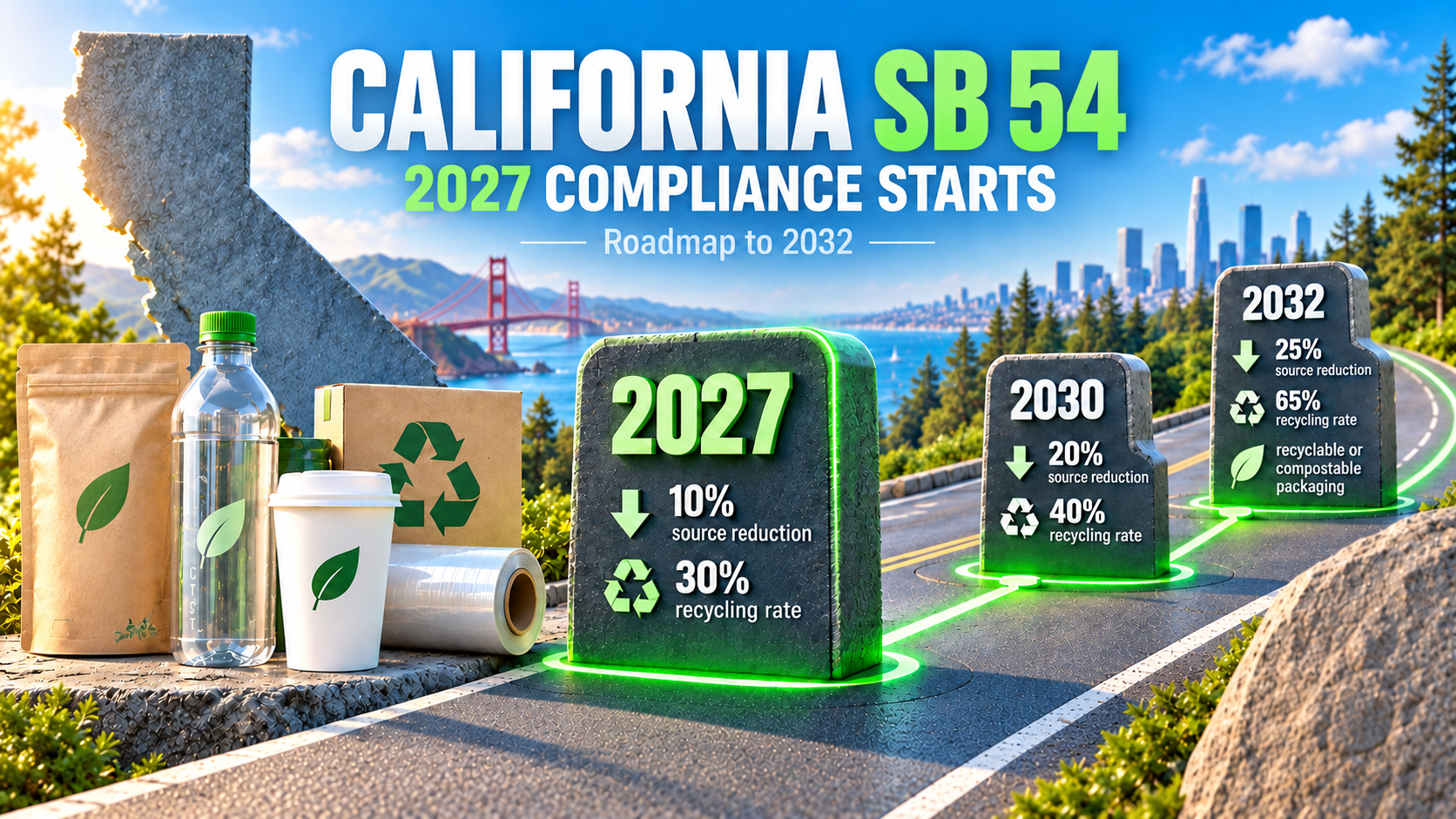
- Full roadmap: source reduction climbs from 10% (2027) to 20% (2030) to 25% (2032); recycling rate from 30% to 65%
- Two lawsuits are pending against SB 54, but neither has paused enforcement so far
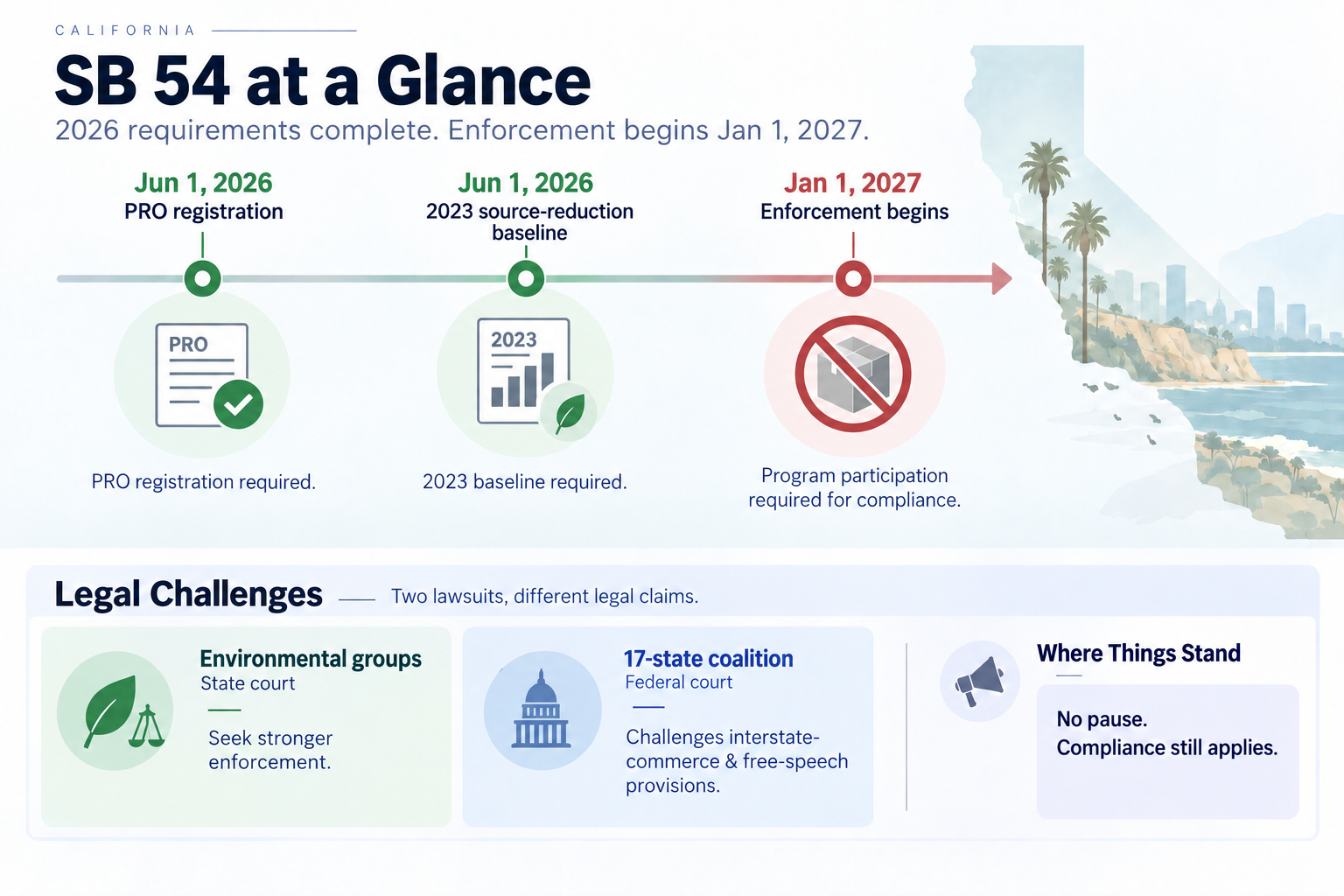
Two deadlines have already come and gone, one day apart. By May 31, 2026, producers had to submit their 2023 baseline supply report and 2025 source-reduction report. Then, by June 1, 2026, they needed to establish an applicable compliance status: participate in an approved Producer Responsibility Organization (PRO) plan — Circular Action Alliance is currently the only one covering California — obtain approval for an independent-producer plan with CalRecycle, if eligible, or, for smaller companies, apply for the small-producer exemption (less than $1 million in gross sales in California in the most recent calendar year).The deadline that matters most comes next: January 1, 2027. From that point on, selling covered packaging in California without a required approved pathway or a valid exemption stops being a missed target. It becomes a compliance failure — the shift from a law that exists on paper to one that is actively enforced.
That shift hasn't been slowed down by the two lawsuits currently testing SB 54, even though they pull in opposite directions. One was brought by environmental groups (Californians Against Waste Foundation, the Natural Resources Defense Council, and Oceana) in California state court. It argues the final regulations were weakened, letting recycling methods that generate hazardous waste still count as recycling and letting some covered products escape regulation — a challenge aimed at tightening enforcement, not loosening it.
The other is a 17-state federal coalition led by Nebraska, joined by the National Association of Wholesaler-Distributors, in federal court. It makes two separate claims. First, that SB 54 improperly burdens interstate commerce. Second, that the law violates free-speech protections: SB 54 bars producers from telling customers, at checkout, how much of the price covers the program's fees, and the coalition argues that ban itself is unconstitutional. That coalition filed for a preliminary injunction on August 19, 2026, but the hearing isn't scheduled until January 15, 2027 — after enforcement already begins — and no ruling has been issued.
Neither case has paused anything so far. Compliance obligations stand regardless of how either one turns out.
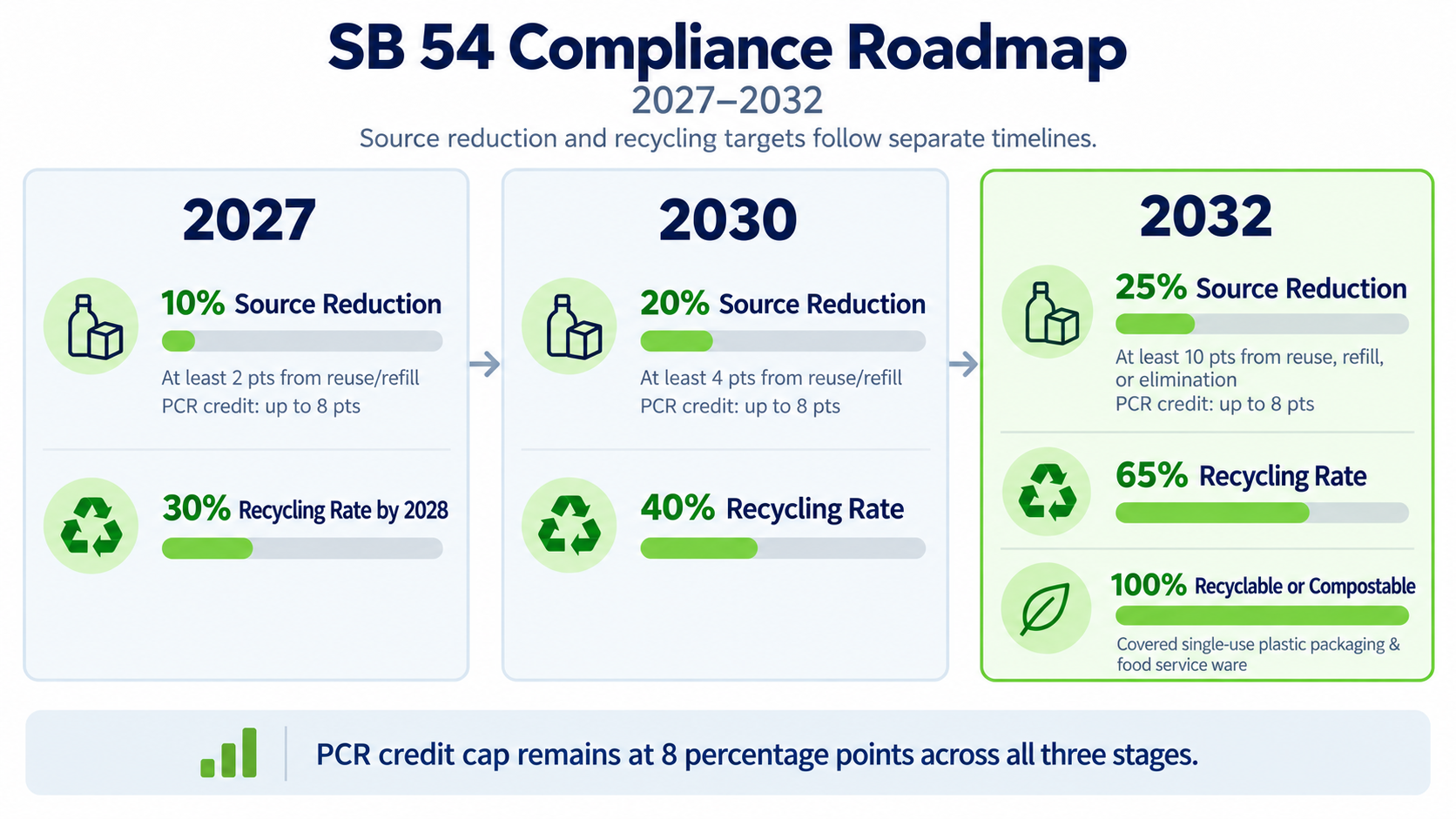
From here, SB 54 tightens in three steps. Each one raises the bar on two measures at once: source reduction (how much single-use plastic packaging gets placed on the market in the first place) and recycling rate (how much of what's sold actually gets recycled afterward).
By 2027: the source reduction target is 10% from the 2023 baseline. Of that 10%, at least 2 percentage points must come specifically from reuse or refill systems, not just lighter packaging. Recycled content (PCR), on the other hand, works differently: it isn't a direct reduction, but a separate "alternative compliance" credit that can offset at most 8 percentage points of that same target — and only for PCR added on top of what a company was already using in 2023. PCR already baked into that 2023 baseline doesn't get counted again. This 8-point cap on the PCR credit stays in place at every stage through 2032. Beginning in 2028 — the recycling-rate track runs on its own separate schedule — the recycling rate target is 30%.
By 2030: the source reduction target rises to 20%. Of that, the reuse/refill minimum doubles to 4 percentage points. The recycling rate target climbs to 40%. The PCR credit cap stays at 8 percentage points.
By 2032: the source reduction target reaches 25%. Of that, the reuse/refill/elimination minimum jumps to 10 percentage points. This is also the point where "elimination" — removing packaging entirely, not just reusing or refilling it — starts counting toward that minimum alongside reuse and refill. The recycling rate target reaches 65%. By this same year, all covered single-use plastic packaging and food service ware sold in California must be either recyclable or compostable.
One detail is easy to miss across all three milestones: the source-reduction credit a company can claim through post-consumer recycled (PCR) content never moves. It's capped at 8% in 2027, and still capped at 8% in 2032. That's a deliberate design choice. California wants recycled content to help, but not to substitute for genuinely using less plastic or building out reuse systems. For a buyer making sourcing decisions, recycled content still matters, especially when it's backed by verifiable certification. But it isn't the lever that gets a packaging line into compliance on its own. It's the recycling-rate side of the roadmap where a real, documented closed-loop recycling pathway pays off — material that's actually collected, reprocessed, and put back into use, not just recyclable in theory.
January 1, 2027 is close enough that it's already worth building into sourcing conversations for packaging lines that sell into California. The ongoing litigation isn't a reason to wait, either. Unless a court says otherwise, the schedule above stands.
REGENPLAST will keep monitoring both the litigation and any adjustments to these targets as the compliance deadlines get closer.
[References]
California Public Resources Code § 42057 (statute text) → Read the Source
California Public Resources Code § 42051 (sale/distribution prohibition) → Read the Source
Ropes & Gray, "California EPR Update – SB 54 Regulations Approved and in Effect; Producer Registration Required by June 1" → Read the Source
CalRecycle, "SB 54 Plastic Pollution Prevention and Packaging Producer Responsibility Act — Permanent Regulations" → Read the Source
Steptoe, "California's Sweeping Packaging Law Under SB 54: Status Update and Litigation Overview" → Read the Source
Atlantic Packaging, "Deep Dive: California's SB 54 Source Reduction Requirements, Explained" → Read the Source
EPR Group Consulting, "Source Reduction Requirements for Plastic Packaging and Food Service Ware" → Read the Source
NRDC, "Environmental Groups File Suit Against CA's Weakened Plastic Pollution Regulations" → Read the Source
EPR Atlas, "State of Nebraska et al. v. Heller et al.: Packaging EPR Litigation Status" → Read the Source
Circular Action Alliance, "California" program page → Read the Source
Buchalter, "California's SB 54 Packaging Law: Don't Miss the May 31 and June 1, 2026 Reporting Deadlines!" → Read the Source
Mayer Brown, "California's SB 54 EPR Regulations Take Effect: Key Deadlines and Compliance Obligations for Producers" → Read the Source