
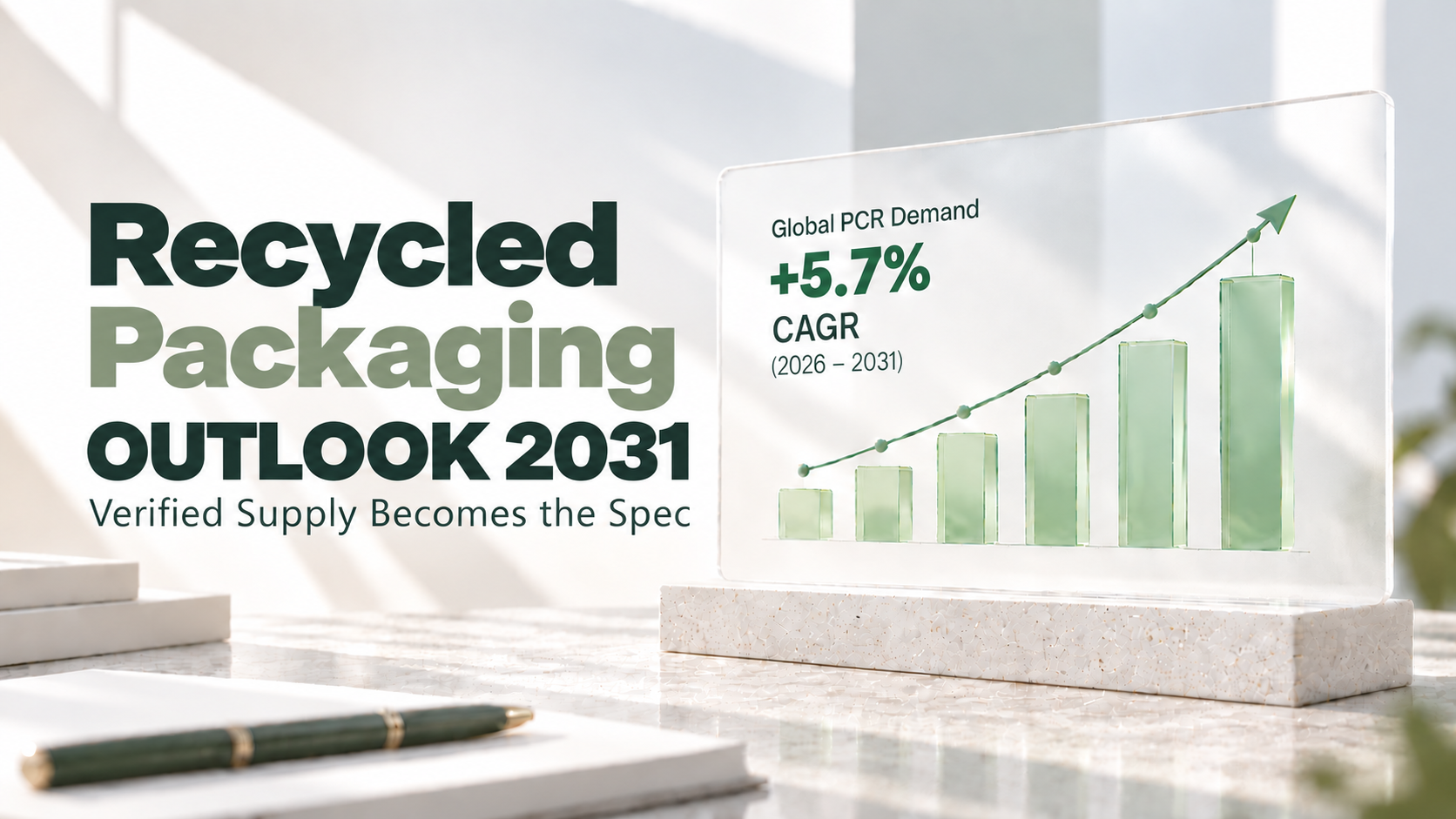
For years, "recycled content" in packaging was largely a marketing line — a percentage on a spec sheet that signaled good intentions more than a firm requirement. That's changing. A growing body of industry data suggests recycled content is becoming a baseline specification that buyers check for, not a bonus feature they ask about. Here's what the numbers say about where post-consumer recycled (PCR) packaging is headed through 2031, and what it means for sourcing decisions today.
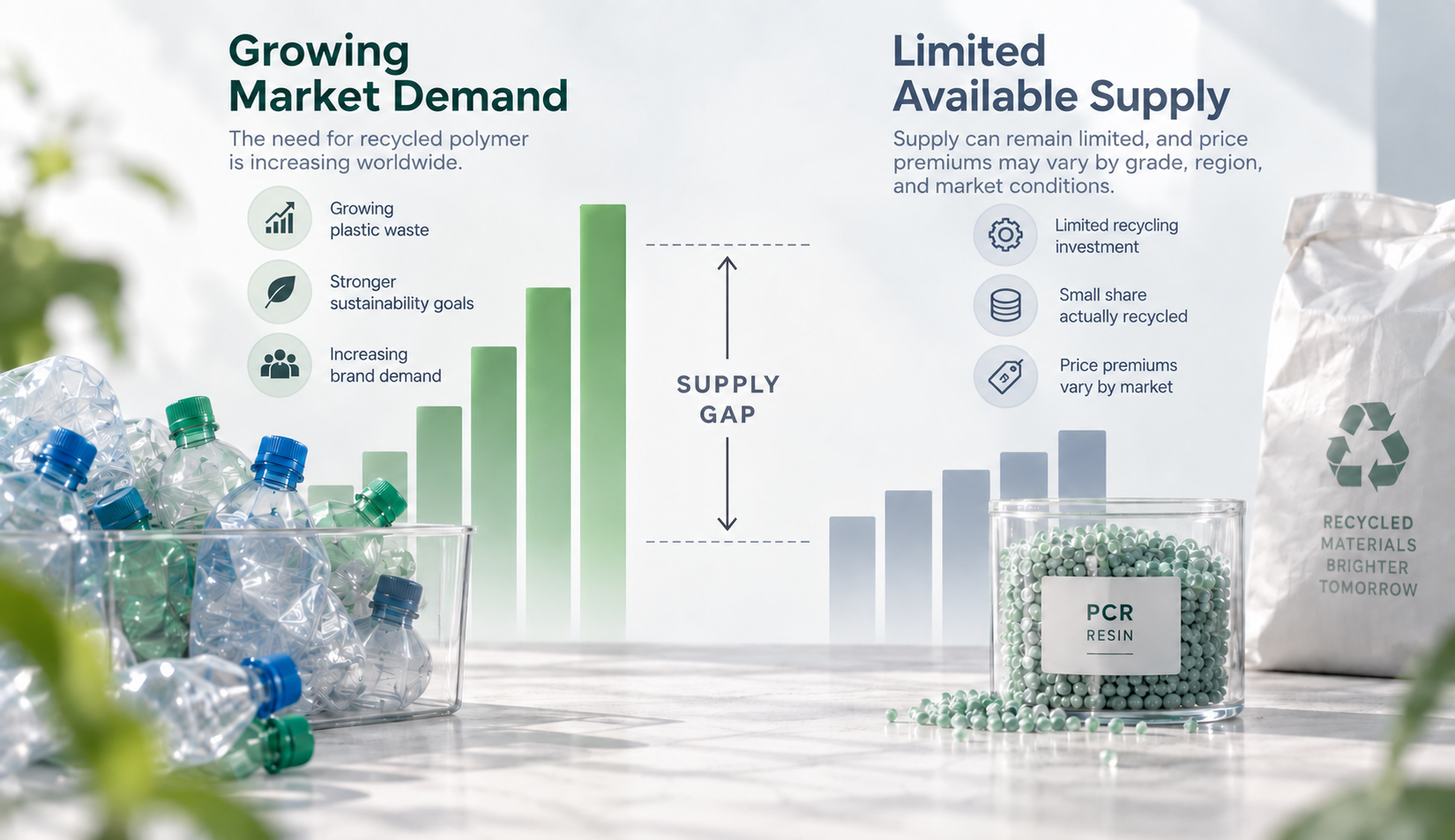
Industry analysis has consistently flagged a structural gap between how much recycled polymer the market wants and how much is actually available. PCR resin can command a premium to virgin resin, depending on polymer grade, quality, region, and market conditions — and this volatility can complicate long-term investment and procurement decisions.
Global plastic waste generation more than doubled between 2000 and 2019, according to OECD data cited in Resource Recycling (2026), yet only a small fraction of it was actually recycled — a mismatch that has kept high-quality recycled feedstock in tight supply, particularly where traceability and documented chain-of-custody are required. For buyers, the practical takeaway is that a reliable, verified source of recycled material is becoming a genuine differentiator, not just a nice-to-have.
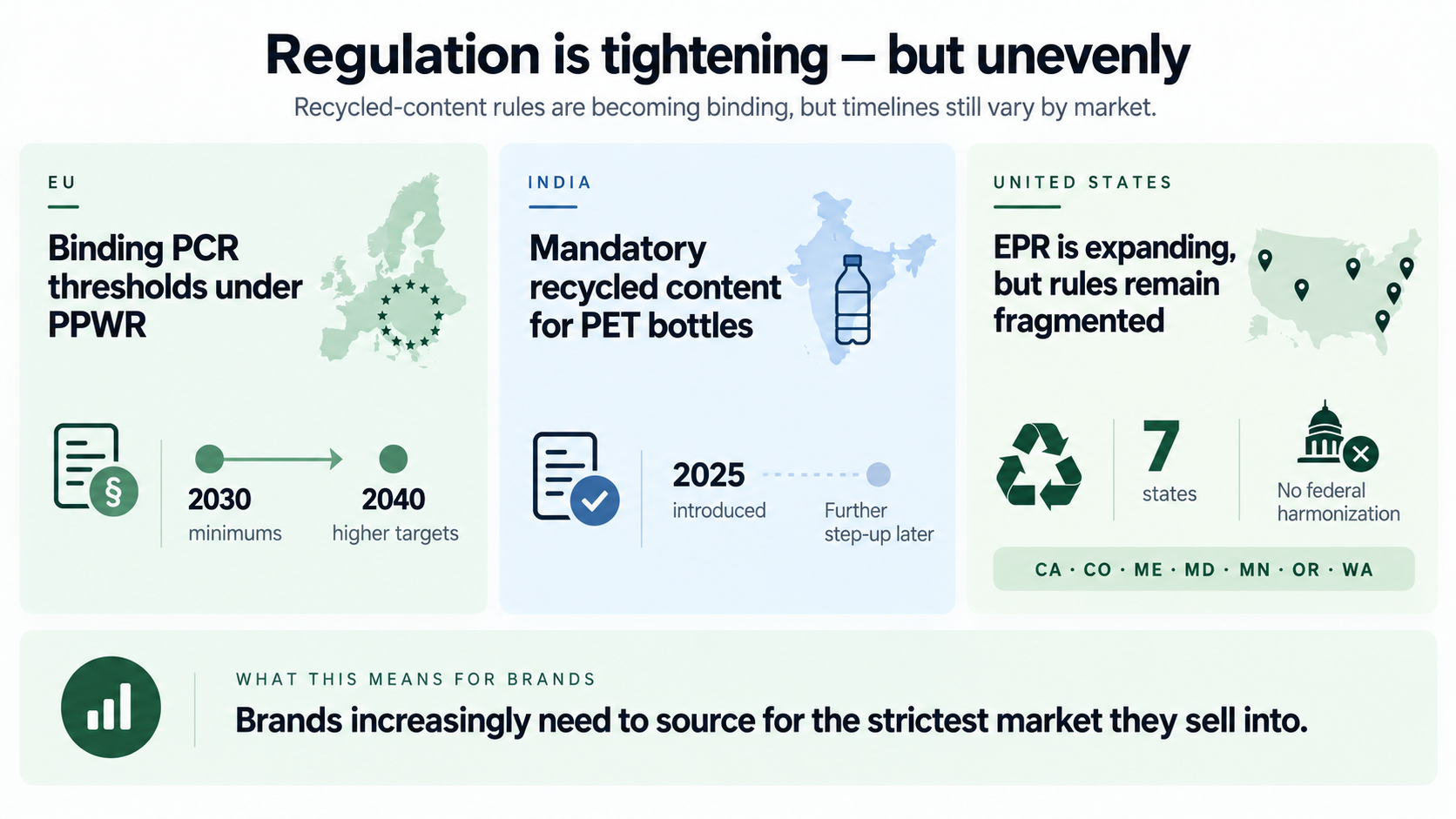
Recycled-content requirements are moving from voluntary targets to binding law in several major markets. The EU's Packaging and Packaging Waste Regulation establishes mandatory minimum post-consumer recycled-content thresholds beginning in 2030, subject to the regulation's implementation timeline, with higher thresholds scheduled for 2040 — and individual countries have moved even faster — India introduced a mandatory recycled-content requirement for PET bottles in 2025, with a further step-up targeted for the end of the decade. In the U.S., the picture is more fragmented: EPR programs currently exist in seven states, and there is still no federal harmonization.
That unevenness matters for any brand selling across state or national lines — sourcing decisions increasingly need to satisfy the strictest market a company ships into, not the loosest one.
Mechanical recycling — cleaning and reprocessing existing plastic rather than breaking it down chemically — remains the established, principal source of PCR packaging supply today, and is projected to stay that way through the rest of the decade. It's a mature, well-understood process, and it keeps getting more reliable: recycled PET in particular is projected to keep growing at a solid mid-single-digit annual clip, helped along by better sorting technology and wider adoption of deposit-return systems that improve both collection volumes and material traceability.
Chemical recycling, which breaks plastic down to a molecular level, is also being developed and expanded as a complementary technology — including new capacity coming online in Europe — although projects can take years to permit, finance, and build. Most forecasts see it adding to overall supply over the next decade rather than displacing mechanical recycling. For buyers, the takeaway is straightforward: sourcing built on mechanically recycled, third-party-verifiable material isn't a placeholder — it's the foundation the industry is actually scaling on today.
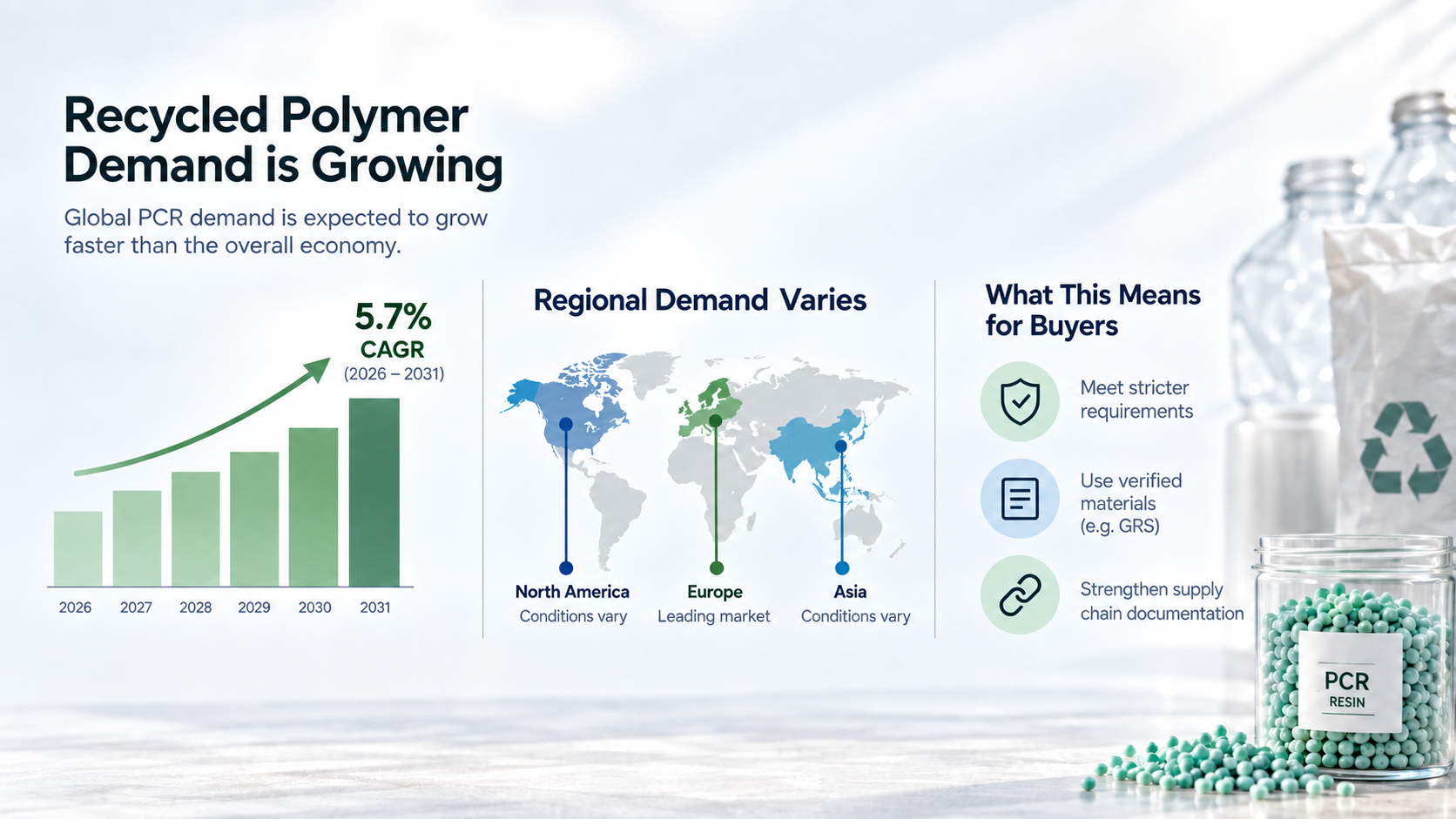
Recycled polymer demand is forecast to keep growing at a pace that outstrips general economic growth over the next five years, with market analyst Smithers (via Resource Recycling, 2026) projecting roughly 5.7% annual growth (CAGR) in global PCR consumption from 2026 to 2031. Europe has generally been a leading market for recycled-content policy and demand, while market conditions in Asia and North America vary substantially by country, polymer, and end-use sector.
For buyers serving markets with stringent recycled-content requirements, third-party verification and chain-of-custody documentation — where appropriate, including certifications such as GRS — can strengthen supplier qualification and improve the documentation available for recycled-content claims, although they do not by themselves resolve supply, price, or material-quality constraints.
[References]
- Resource Recycling, "Five trends shaping PCR packaging to 2031" (2026-04-29): https://resource-recycling.com/plastics/2026/04/29/five-trends-shaping-pcr-packaging-to-2031/
- Smithers, The Future of PCR Packaging to 2031 (2026), cited in Resource Recycling
- OECD, Global Plastics Outlook: Economic Drivers, Environmental Impacts and Policy Options (2022): https://www.oecd.org/en/publications/global-plastics-outlook_de747aef-en.html