
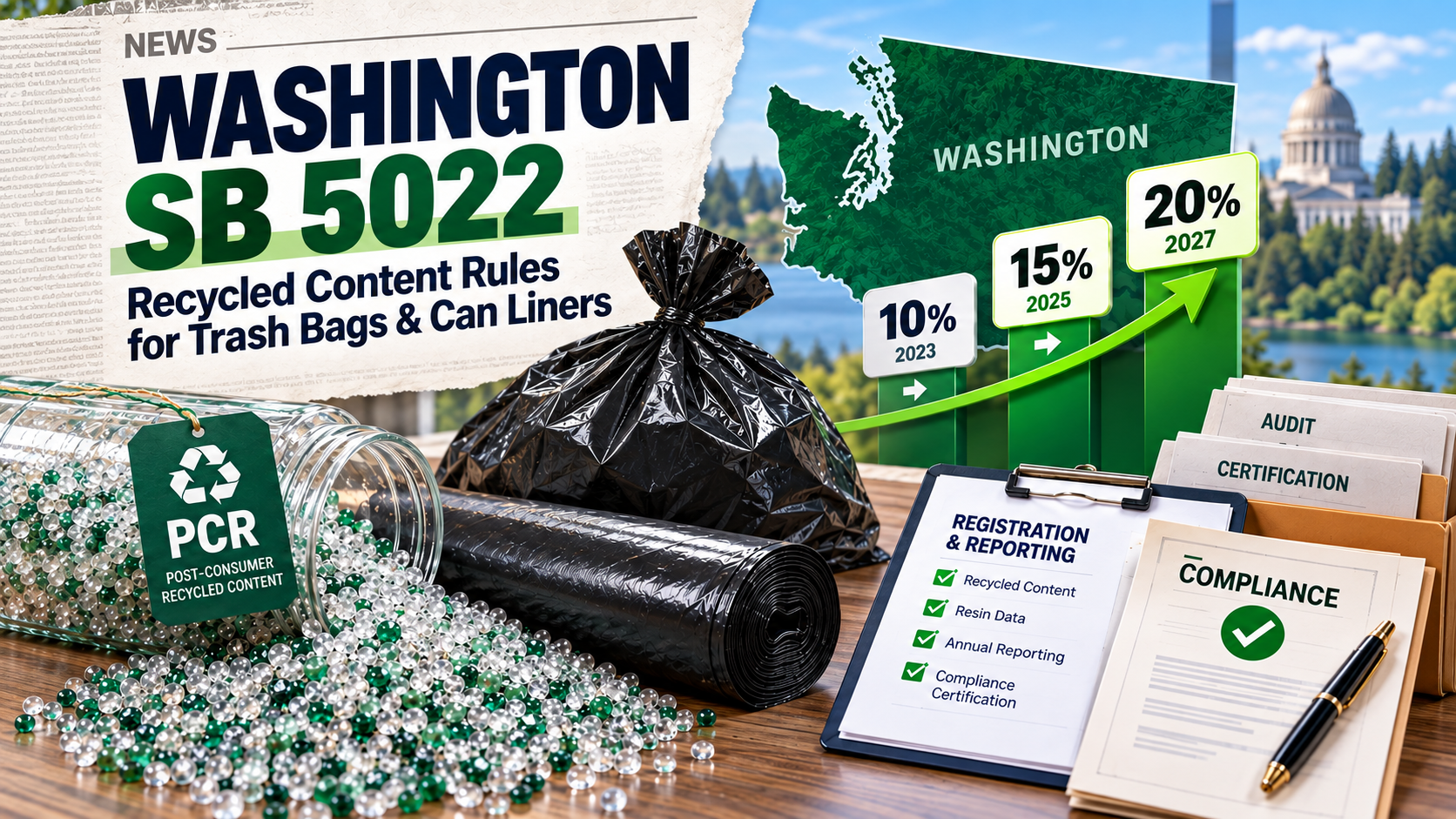
- Washington's SB 5022 (codified in Chapter 70A.245 RCW) is a 2021 plastics law with three parts: minimum recycled content, a ban on some polystyrene foam, and a rule that makes single-use foodware available only on request.
- The recycled-content part covers several plastic products, trash bags among them. For trash bags, the required content rises on a set schedule — 10% in 2023, 15% in 2025, and 20% in 2027.
- Compliance is measured once a year, as a weighted average by weight across a producer's products in each category. Producers register and report their own resin data to the state Department of Ecology by April 1, and they must certify that the reported percentages comply — either through a qualifying third-party certification or a responsible official's self-attestation.
- The law is already being enforced, with real penalties behind it. In October 2024, Ecology fined 35 companies a combined $416,554 for using too little recycled content in beverage containers and trash bags.
- Ecology has also said many producers may not have registered at all, and it announced plans to use audits to find them.
- REGENPLAST holds GRS certification for its recycled material and offers can liners and garbage bags made with it — so buyers have a verified way to meet Washington's rising minimums (15% now, 20% in 2027), with content they can document well before an audit.

SB 5022 is a Washington plastics law, enacted in 2021 (Chapter 313, Laws of 2021) and codified in Chapter 70A.245 RCW. It grew out of a broader state push to cut plastic waste. A related recycled-content bill for plastic beverage containers had cleared the Legislature a year earlier but was vetoed amid COVID-19 budget concerns. When SB 5022 became law the next year, an extended-producer-responsibility (EPR) program had been dropped from the final version. So the law leans on product-specific requirements rather than a full EPR system that makes producers finance a statewide packaging program — though covered producers do still pay annual registration and reporting-program fees.
The law works on three fronts. First, it sets minimum recycled content for certain plastic products. Second, it bans some expanded polystyrene (EPS) foam — packing peanuts from 2023, and foam foodware like cups, plates, and clamshells from 2024, with raw meat, produce, and egg cartons exempt. Third, it makes single-use foodware — utensils, straws, condiment packets, and lids — available only on request. This article focuses on the first front, since that is the part that reaches trash bags and can liners.
The recycled-content rule sets a minimum share of post-consumer recycled (PCR) content for each covered product category. PCR is plastic recovered from used items, such as milk jugs and bottles, and reprocessed into new material. What matters for compliance is how the share is counted: once a year, as a weight-based average across a producer's covered products in each statutory category sold in or into Washington, rather than from a single product sample. In other words, the target is met at the category level, not unit by unit.
Trash bags are one of those covered products, and their required PCR share climbs in three steps: 10% in 2023, 15% in 2025, and 20% in 2027. The 15% level applies today. Other products run on their own timelines. Plastic beverage containers move from 15% (2023) to 25% (2026) to 50% (2031); household cleaning and personal care containers start at 15% in 2025; and dairy milk and 187 ml plastic wine containers become subject to the 15% minimum in 2028, with annual reporting from 2029.

Compliance runs on the producer's own numbers, but with a required certification behind them. Each year, producers register and report through Washington's Waste Reduction Portal, entering their resin data: recycled versus virgin content, by resin type, and total weight sold into the state. They then have to certify that the reported percentages comply with the law. WAC 173-925-040 allows two ways to do that — a certification from a qualified third party (ISO-accredited, or another accrediting body Ecology accepts), or a responsible official's signed attestation that the figures are true and accurate. A third-party certificate is not required in every case, but a compliance certification of some form always is.
From there, Ecology can check the numbers through audits and investigations. The rules let it request the records behind a reported figure — resin pounds by product type, the basis for any national or regional estimate, and evidence for any small-producer exemption — and under WAC 173-925-080 the producer has 30 days to respond. In practice, an audit may require a producer to substantiate its filing with its own underlying records and supporting documentation.
The reviews have teeth. In October 2024, Ecology fined 35 companies a combined $416,554 for using too little recycled content in beverage containers and trash bags. Individual fines ran from $39 to $67,196, sized to how much a producer sold in the state and how far it fell short.
Ecology has also said many producers may never have registered, and it announced plans to use audits to find them. In short, the certify-then-audit system is more than a paper requirement: Ecology has already imposed penalties for missing recycled-content targets and has made unregistered producers an enforcement priority.

The obligation sits with the "producer" — usually the manufacturer, or the owner or licensee of the brand or trademark the product is sold under. Depending on the statutory hierarchy and Washington's jurisdiction over those parties, an importer or distributor can be treated as the producer instead. Either way, if your trash bags or can liners reach Washington shelves, the recycled content is yours to report, certify, and defend.
That is the catch with a self-reported system: a filed number is only as strong as the records behind it. If Ecology audits and the documentation is thin, the figure is hard to stand behind.
This is where documentation earns its keep. No certification is a statutory safe harbor, but a chain-of-custody standard like GRS (Global Recycled Standard) can help substantiate recycled-content claims across the supply chain. It works best alongside the rest of the record set — category calculations, resin and weight data, supplier documentation, and records of what was sold into Washington. One caveat: if a producer relies on a third-party certification for its Washington filing, it should confirm the certifier meets Ecology's qualification and review requirements.
First, the 2027 step-up. Trash bags move from 15% to 20%, so sourcing decisions made in 2026 should aim at 20%, not just today's 15%.
Second, registration and audits. Ecology has flagged unregistered producers as an enforcement priority, which makes registration, accurate reporting, and a defensible certification matter as much as the recycled content itself.
Third, the rest of the schedule. Beverage containers rise to 25% in 2026, household and personal care containers began at 15% in 2025, and dairy milk and 187 ml wine containers join at 15% in 2028 — so a producer with several product lines may face more than one deadline at once.
This is exactly the kind of regulation REGENPLAST is built to help with: its recycled material is GRS-certified, giving buyers a verified starting point for meeting Washington's rising PCR minimums — 15% now, 20% in 2027.
References
Washington State Department of Ecology, "Recycled content minimums" → Read the Source
Washington State Legislature, "Chapter 70A.245 RCW — Recycling, Waste, and Litter Reduction" → Read the Source
Washington Administrative Code, "WAC 173-925-040 — Annual registration and reporting requirements" → Read the Source
Washington Administrative Code, "WAC 173-925-080 — Penalties and audits by the department" → Read the Source
Resource Recycling, "COVID-19 fallout prompts veto of recycled-content bill" (2020 ESHB 2722 veto) → Read the Source
Packaging Dive, "Washington state fines 35 companies violating recycled plastic law" → Read the Source